
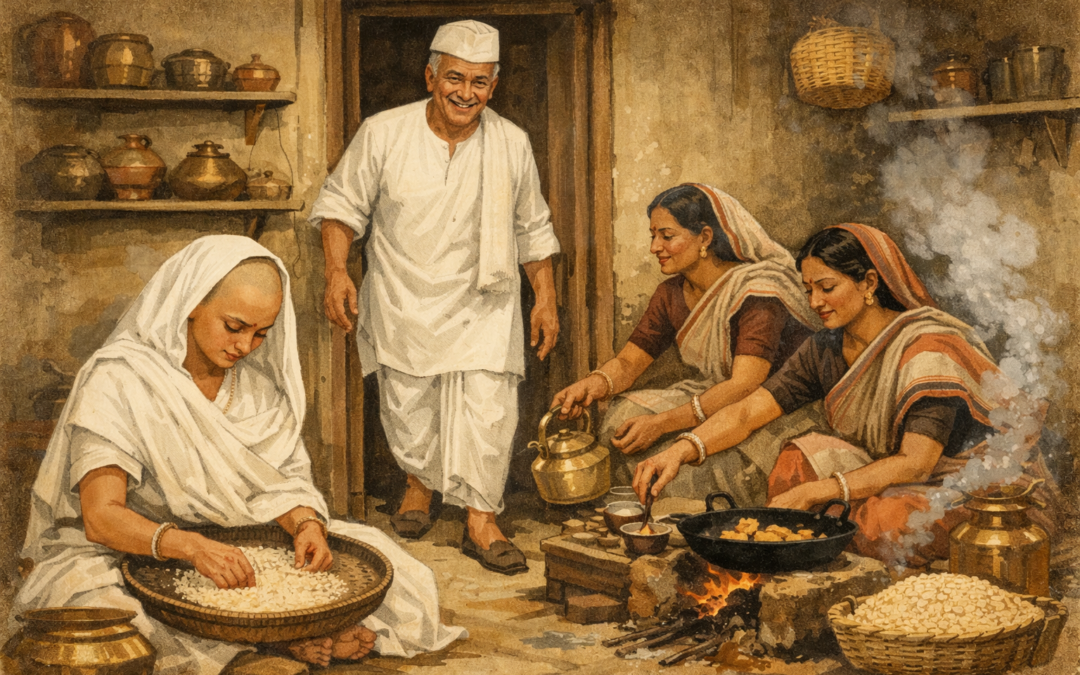
It was quite unexpected for Dadu* to arrive home at such an early hour. Typically, Dadu was so engrossed in his duties at the trade house where he assisted merchants and handled goods prudently, that he would only return moments before Choti Ma* lit the evening lamp.
However, today, he walked in during tea time, looking excited.
“Did you hear the news?” he exclaimed as he rushed over to Dadi* and Chotti Ma, who were busy organizing the utensils for the evening snacks and tea.
I was cleaning the rice, sitting in a corner, as per the instructions of Chotti Ma. We looked at Dadu bemused. He was always in a sombre mood, something seemed different today.
“Pandit Ishwar Chandra Vidyasagar took the initiative and successfully conducted the first widow remarriage at his own expense. He married off ten-year-old Kalimati, a widow, to his colleague Siris Chandra Vidyaratna from Sanskrit College.” Dadu was panting with exhilaration, while Dadi’s eyes widened in surprise to hear the news. Chotti Ma stood transfixed.
I directed my focus back to the plate of rice, while Dadu continued his tale.
“There were some objections and challenges, but Vidya Sagar remained resolute and saw the wedding through. A truly remarkable man!” He paused for a bit and asked, “You women folk know, I suppose that widows’ remarriage act was passed on July 16th this year? Widows are now legally allowed to get married again. And four months after the law was passed, Pandit Ishwar Chandra took this bold step.”
The confusion became palpable as the two ladies shook and nodded almost simultaneously, while I sat still, with my head bent. I somehow guessed where this was leading to.
“What point are you trying to make?” Baba’s authoritative voice cut through the conversation as he entered after his school hours. He was a Bengali teacher.
“I find it hard to believe Pandit Ishwar Chandra could take such a step. Widow remarriage! Bah!” Baba shook his head in disapproval. “Where is society heading?” he exclaimed with an emphatic stamp of his foot.
“Why?” Dadi interjected, her voice barely above a whisper, wary of Baba’s temper that seemed to loom over the household. Baba had little patience, and Chotti Ma, who usually spoke assertively, always adopted a quieter tone around him.
“Why do you ask?” Baba scoffed.
“I was saying, you as a teacher should also advocate such ideas, rather than talking about it with contempt. Why can’t widows have a lif…,” Dadi’s words trailed off abruptly as she caught Baba’s stern glare.
“I think Sasuri* has a point,” Chotti Ma added, only to be quickly dismissed by Baba.
The news of widow remarriage was received by the two women with enthusiasm, not evoked by sympathy to help me escape the confines of this house, but to navigate this topic in a way that would help them wash their hands off me. However, Dadu, I knew was steering the conversation towards helping me break the shackles that bound a widow. Ironically Baba, having had official education to become a teacher, had a narrow outlook in such matters.
I wasn’t sure if the news of widows’ remarriage was one for me to rejoice or cower. I didn’t even consider myself eligible to dream about a remarriage. The impact of people constantly calling me a cursed girl, had almost made a mark in my mind that whoever got associated with me, would perish, though I was aware that it wasn’t the eternal truth.
Who am I? Perhaps it would be better for me to recount my life story, beginning with my birth in 1837 in Calcutta.
The arrival of a girl in the family was hardly a cause for celebration, and when I entered the world, there was no joy at all. My birth was overshadowed by tragedy; my mother died giving birth to me, leaving me to navigate life on my own, outside the warmth and safety of her womb.
They named me Sati.
Before long, my father remarried. Chotti Ma then gave birth to three children: the eldest, Dhyan, was two years younger than me, followed by twin sisters, Parvati and Indrani, who celebrated their fifth birthday on the day of my wedding at ten. Chotti Ma’s feelings towards me were nothing short of contempt. Baba had little time to notice my daily struggles under her rule. He rarely spoke to me.
Though Dadi never openly expressed any bitterness towards me, it was clear that she too believed that I was a cursed child. She turned a blind eye to Chotti Ma’s critical approach towards me.
However, Dadu had a soft spot for me, although he had to conceal his affection to avoid earning the wrath of others.
I still vividly remember one morning when, half-awake, Bua* shook me from my dreams and Dadi doused me with cold water. I shivered as the icy water splashed against my skin.
“Get her ready. The auspicious time is at seven,” Dadi instructed Chotti Ma, and within minutes, I was hastily draped in a long sari, wrapped around my fragile figure in layers to get the edge as a pallu*.
By the time I was taken to the sacred altar, a boy was already seated there. Several rituals ensued, and I vaguely recall him tying a yellow thread around my neck while the women surrounding us blew conch shells, a sound that was oddly frightening.
I sat through the process, paralyzed with fear, longing for sleep but forced to touch the feet of everyone present, starting with that half-asleep boy next to me, who greeted me with a shy smile.
“We are fortunate that someone agreed to accept her as a daughter-in-law. This cursed child consumed her mother the moment she was born. Now, I must endure her presence until she is of age and then send this unfortunate girl off to her husband’s home,” Chotti Ma prayed, looking upward with clasped hands.
All of it felt far too complex for my young mind, and I seized the first opportunity to fall asleep. My life, already difficult under Chotti Ma’s tyranny, took a turn for the worse after the so-called marriage ritual. I was now expected to remain wrapped in a nine-yard sari, forbidden from playing or moving freely.
“You’re married now, do you understand? It’s our duty to ensure you are handed over to your in-laws in one piece, so stop running and jumping. If you hurt yourself, and break your limbs, we’re all finished,” Chotti Ma found another way to torment me. Her words confused me. I’d played and jumped without injury till then. My tiny brain came to a conclusion that perhaps, once they labelled it marriage, girls somehow became prone to breaking bones.
The days and nights dragged on endlessly, feeling like an eternity. Occasionally, the boy who sat next to me at the altar visited with his parents, and I caught him glancing my way from the corner of my eye. It was all quite perplexing. Dadi often sent me inside while they gathered over tea and samosas.
I appreciated their visits because of the jingly bangles and sweets they brought. The boy’s mother always made a point of giving me a hug. “We’ll take you home soon,” she would say reassuringly, though I never understood why they never took me home with them. I always dreamt of their house having lot of jingly bangles and sweets.
Then one fine day the house erupted in celebration; I had reached puberty at the age of 15. The occasion was marked with great festivity. I overheard Bua, Dadi, and Chotti Ma discussing the next steps.
“We should let them know to come and take her on the seventh day. They can have the first night there,” Bua chuckled, nudging Chotti Ma, who too giggled, leaving me bewildered as I tried to decipher the meaning of ‘first night,’ and why it elicited such amusement.
Then, chaos ensued. On the eve of my departure to my new home, a visitor arrived from the boy’s village. He burst in, crying out, “He is dead! A snake bit Amitava while he was bathing in the pond!”
Chotti Ma and Dadi began wailing, beating their breasts. “Cursed soul,” they said, looking at me.
It would be an understatement to say I suffered both mentally and physically. The women who arrived the following day, thought pinching my cheeks and calling me cursed was part of their mourning. Some even slapped me and twisted my arms.
“What a misfortune! I’ll be stuck with her forever. God, why couldn’t the snake have bitten her instead?” Chotti Ma ranted.
Dadi’s displeasure too was palpable from the frown on her face. The men folk looked sober. Bua, the ever gentle woman, sat next to me and consoled me.
Ten days later, the family decided that I no longer deserved my long, beautiful hair. They determined this was how a widow should live. The priest was the one to reinforce the decree.
The village barber was summoned. He mercilessly cut through my hair, as I was made to sit on a stone in the backyard. I fought back tears as my long tresses fell to the ground.
“We will call for you as needed,” Baba instructed the barber while handing him money and a food packet. The middle-aged barber eyed me greedily, likely thinking, ‘This girl is just 15; my earnings from this household are secured.’
“From now on, no more going to pray at the temple or anywhere, understood?” Baba warned, pointing a finger at me. “No one wants to talk to you. The neighbours have made it clear: keep her inside. Better stay in this room.” He then turned to Chotti Ma, saying, “Tell her to apply sandalwood to her shaved head, give her those white sarees I got, and I expect Ma has told you to remove the yellow thread from her neck at twilight today.”
Chotti Ma nodded, muttering, “If Amitava had died after she spent at least one night with him, this unfortunate girl would have been there already. What terrible luck that this happens before the marriage got consummated.” She slapped her forehead in distress.
Everything felt surreal.
As hours slipped into days, which transformed into months and then years, I realized that the vast shifts in the universe had no bearing on my own existence. Dhyan rarely engaged with me in conversation anymore, and both Parvati and Indrani were cautioned against entering my room. My life had become largely confined to the small space of my room, apart from the occasional summons from Chotti Ma or Dadi to assist in the kitchen, whether it was cleaning rice or peeling vegetables. While I was permitted to step onto the verandah to hang my clothes out to dry, I was again reminded not to linger or gaze too long at the outside world. The vibrant life beyond the walls of this home had disappeared from my view a long time ago.
The discrimination within the household was stark. Parvati and Indrani, both 10, were allowed to attend school, while I had not stepped into one. However, rumours suggested that their schooling would soon cease, as Parvati had an impending marriage in a couple of years, and efforts were underway to find a suitable match for Indrani as well, to conduct both the weddings together. By then, Dhyan would be ready to seek a bride since he would have passed out of school.
“Only this unfortunate soul will keep haunting us,” Chotti Ma often lamented alongside Dadi. During her visits, which weren’t frequent, Bua would try reasoning with them, saying it wasn’t my fault after all. However, the two turned a deaf ear to her. Dadu occasionally stood by my side, but his voice often got drowned out by the clamour around us.
Things went ahead in everyone’s life, as planned. Both Parvati, and Indrani got married on the same day, and awaited to join their spouses. Dhyan had started working in a textile shop. I was the only one confined to my room wearing the same white saree and a head shaven from time to time and smeared with sandalwood.
Today I learned about a man named Ishwar Chandra Vidyasagar who had officiated the marriage of a 10-year-old widow.
Clearing his throat, Dadu addressed my Baba. “Listen, Jayendra, let’s approach this judiciously. Since a widow has been remarried, surely there will be others willing to follow that path. Why shouldn’t we be among them and seek a groom for Sati?”
For once, Dadu had the backing of Dadi and Chotti Ma, allowing him to press his case. The discussion intensified, with Baba opposing while the three of them advocated for my marriage. Dadu genuinely wished to see me settled, always speaking of me having a family of my own, while the two women seemed more focused on finding a way to rid the home of what they labelled a cursed soul.
Baba’s arguments began to lose strength as Chotti Ma pointed out that Dhyan’s prospects for marriage with affluent families were getting jeopardized by the presence of a widowed sister—someone they considered a burden.
“Marrying off Sati would be the most practical decision, bringing down all our worries and distress,” Dadi asserted. But Baba stood undaunted and then in a moment of frustration Chotti Ma dropped a bomb.
“If you, who lost your wife, could have found a bride, why can’t a widow like Sati, whose marriage hasn’t even been consummated, find a groom?”
I am sure Chotti Ma must have panicked after uttering those words that impulsively came out of her mouth, but it had hit the right spot. Baba stood still for a while. Dadi, though shocked initially, threw an appreciating glance at Chotti Ma.
With Baba rendered speechless, the decision was made to find a husband for me.
As usual, I found myself excluded from these discussions, even though they revolved entirely around my life. Did anyone care to know if I wanted to marry? What sort of groom did I envision? The reality was that a widow had no voice in determining her own fate, and the choices were made without any input from me.
A flurry of activity ensued in the household, and in three months they announced that my marriage had been arranged.
‘With whom?’ I dared not inquire. However, I overheard enough to discern that he belonged to the educated class, and worked as a clerk in the high court. He was previously married and had lost his wife. Whether his wife had died before the marriage was consummated, was something I wasn’t aware of.
“The family staunchly supports the widow re-marriage act. Even though they could have sought out an unmarried girl, they have graciously accepted Sati as their daughter-in-law,” Dadu enthused about the family they deemed generous and kind.
At the age of nineteen, I was undoubtedly far more mature than a ten-year-old bride. I patiently participated in the rituals and respectfully touched the feet of each elder before my husband invited me to join him in our upstairs room.
Filled with a mix of excitement and apprehension, I observed as he opened the door and led me inside, where a child rested on the bed.
“This is my son, Abhisumanth,” he declared with a gesture towards the boy dozing peacefully. “My wife, Sumati, became ill soon after giving birth and tragically passed away in August, when he was barely two months old. My family urged me to remarry for the sake of providing a mother for Abhisumanth. Coincidentally, the widow remarriage act had just been enacted, and I hold great respect for the man who relentlessly worked for this cause, Pandit Ishwar Chandra Vidyasagar. As a result, I made the decision to take a widow as my wife. Shortly thereafter, we found you.”
In an instant, a flood of previously unknown truths washed over me. The others back home were all aware of this child, yet they had deemed it unnecessary to inform me that I was stepping into a new chapter—not just as the wife of a widower, but as a mother to a child.
I remained unfazed, as life’s hardships had equipped me to handle any circumstance with grace. I also realised the depth of sincerity and straightforwardness in the eyes of the man before me.
Even had I known about this child beforehand, I would have opposed nothing regarding the marriage. I had no real option to make a choice, but I viewed this as a remarkable opportunity to offer love to a child without a mother. Only someone who has endured the absence of a mother’s embrace understands that ache.
With a smile on my lips, I picked up the now-awake child, who greeted me with a joyous giggle that aptly matched his name, Abhisumanth—meaning the brilliance of the sun. I held him close to my heart.
The gentle grasp of his tiny hands rekindled a love that had long been dormant within me. Deep down, I carried a nurturing spirit, yearning to both give and receive affection.
In a way, I owe Chotti Ma a thank you for teaching me this tough lesson, in her own grudgeful manner. It has fortified my instinct to care for a motherless child. This will be my primary challenge: to prioritize his happiness, ensuring he never feels the absence of a mother.
Who could deem me a cursed girl? I consider myself fortunate to share my love with a child in need of a mother.
I felt profoundly grateful to the compassionate man who had pioneered widow remarriages.
Author’s Note:
Hindu widows’ Remarriage Act, drafted by Lord Dalhousie, was passed by Lord Canning on July 16th 1856, and enacted on 26th July 1856.
First legal widow remarriage under the Hindu widows’ remarriage Act—-December 7th 1856, Between a ten-year-old widow, Kalimati, and Siris Chandra Vidyaratna in Calcutta.
This story has been published in an anthology named Hawk’s Era by Room9pyblications, featuring stories related to events dating back to the era before 1950.
GLOSSARY
Dadu——–Grandfather
Chotti Ma—Step Mother
Dadi——–Grandmother
Baba——–Father
Sauri———Mother-in-law
Bua*———-Father’s sister
Pallu———–The flowing edge of a saree
Total word count including author’s note, excluding glossary and title: 2996