
Handing Daada a bouquet, I touched his feet. My wife Shraddha, who had made all the arrangements for the day, joined me in seeking his blessings. With eyes filled with unspoken gratitude, Daada accepted the bouquet and, placing his trembling hands lovingly on our head, muttered a small prayer wishing us well. He enquired about our son Varun, and we told him he was just back from his classes and would be there soon to join the fun and frolic.
Age had started weighing heavily on Daada. His health conditions had been waning.
Being the senior-most member of this Home, everyone addressed him thus. Daada had a very soothing name; I vaguely remember having seen it in the register.
*******************************************************************
Shouldering the responsibility of running a senior citizens home would have sounded far from rewarding for the twenty-eight-year-old I was nearly two decades ago. I had completed my management studies from a tier II institute. It was an epoch when job offers poured in for a qualified person like me.
When I stepped into my father’s shoes as the admin of this seven-year-old home named ‘Chhath,’ literally meaning ‘roof,’ it boasted seventeen inmates.
Approaching many a philanthropist, my father had amassed strong financial support to run the institution for the aged. Word of his selfless deed spread far and wide, and affluent people in large numbers expressed their desire to donate to the noble cause.
Life is unpredictable, and unfortunately my father suffered a terminal ailment when he was hardly fifty-seven. While in his deathbed, he held my hands earnestly and literally pleaded with me to run the home after him.
I found myself in an awfully delicate situation. I was just married to Shraddha and had landed up with an extremely lucrative job in Mumbai, with attractive remuneration.
‘Behind every successful man there is a woman,’ they say. I concur with this wholeheartedly.
Sensing my tribulation, my wife gave me her moral support.
If it wasn’t for Shraddha’s encouraging words, I may have faltered and failed to deliver my duty as a son not just to my father, but to all the inmates of Chhath.
“What are we going to do sitting on a pile of money, Aman?” She had asked me.
“Your father’s noble dreams would be ruthlessly crushed, and also what would happen to all the elders who have taken shelter here.”
She wistfully continued, “I understand you are worried about our kids; that they would lose an opportunity of being raised up in a cosmopolitan atmosphere, but look at yourself, you are an educated man today, and you were brought up in this small town. We can give the best to our children wherever we are; it all depends on how we nurture them.”
Her words acted as a catalyst. From then onwards, there was no looking back.
Two decades after that, Chhath has as many as thirty-two inmates. Varun, now sixteen, is a grandson to all of them.
My assets may not run into lakhs, but in my kitty of life I have amassed the blessings of so many elders. That should contribute to my success story.
*******************************************************************
Leaning back in my chair, I admired the way the ‘youngsters’ were enjoying the party. They all looked eighteen.
I heaved a deep sigh of anguish and thought, ‘I wish I could turn back the clock and bring the wheels of time to a stop.’
If I could, then this cheerful demeanor could stay on!!!
Each one had a pent-up, heart-rending tale to reveal. Sahadev uncle, for instance, had lost his wife to acute Pneumonia and, being issueless, decided to take refuge in the senior citizens’ home.
If being childless was Sahadev uncle’s tragedy, others with children had their own melancholic tales to narrate. Kamala Tai’s only son thought it would be a liability to keep her with him and dropped her here one fine morning a decade ago; since then, this has been her abode.
Then there was Henry uncle, who was literally thrown out of his son’s house after all his property was treacherously usurped, leaving him a meager sum for survival.
Not only those with monetary issues, but many who were well-off landed here, too.
Their miserable stories could move even the toughest heart. Once grown up, the children found no time to take care of their parents. That was becoming the trend of the day. It was so very simple to drop them off at a Senior citizen home and feel relieved that the baton had been easily passed on to someone else.
Even though my father never had strict rules about payment, most of the elders who came seeking refuge here were eager to contribute according to their capacity.
Many of them had children with well-paid jobs. Their children found it easy to pay a huge sum, which, in their eyes, was a petty fee that would, in return, help them wash their hands of these oldies, whom they considered serious burdens.
Those who had very little financial support to fall back on, like Sarah aunty, Henry uncle, and Sukhdev uncle, were also welcomed into the loving wings of Chhath. Irrespective of caste, creed, or monetary strength, everyone received the same altruistic treatment, without bias.
Daada was 75 when I took the reins of running this home.
Something regarding Daada was genuinely unique. He never sulked or discussed his past with anyone. While he tried his best to rub his mates’ tears, no one had ever heard him complain about life.
My father told me that when Daada was 70, his son brought him here and put down a heavy bunch of cheques in specific denominations. He also handed his dad enough cash.
“Look here, I am leaving adequate money to last till eternity. Just keep it and don’t bother calling me for anything. I will be busy with an overseas project and might be away from India for long.” This is what he had apparently told my dad. What he indicated by ‘anything’ was that even when Daada dies, he need not be informed.
“We haven’t heard from him after that. He had just written his name in the register and not given any contact details.
I am sure Daada must not have amassed enough wealth to be claimed after his death, or he might have entrusted all his earnings to his son during his lifetime, considering him his pillar of support in old age. A terrible mistake made by most parents,” my father had said remorsefully while narrating the incident to me.
Daada became a source of comfort to one and all at Chhath. His lighthearted disposition made him a favorite among the inmates. My father had developed a great affinity towards him and looked upon him with reverence. Every other inmate would approach Daada whenever they went through an emotional low. He was like a pillar of support to everyone.
*******************************************************************
The party was still in full swing when Pralhad, my office boy, gestured for me to come out. He informed me that someone had left an old man outside in a wheelchair with a letter and an envelope.
When I reached the entrance, I saw an elegant-looking elderly man, probably on the verge of being called a septuagenarian, sitting in a wheelchair, his body contorted to one side and his head hanging precariously. His face was blank.
My greeting also drew no response.
I read out the letter. “I am Arjun Sawant. This old man is my father, Prakash Sawant. He is sixty-eight and is an Alzheimer’s patient. He has become too bothersome. We can handle him no more. There is an envelope with 36 filled cheques to last you for three years. Please don’t bother calling me during this time, unless my father kicks the bucket.
I will get back to you by the end of three years and deposit more money, if he is still breathing. By the way, don’t bother to ask him any questions; he is not in a proper state of mind to give valid answers.”
He had given a phone number, strictly instructing me to contact him only when his father dies.
My hands trembled as I folded the sheet. I was seething with anger to read a letter in a language as filthy as this, devoid of any love or affection for one’s own father.
I wheeled the gentleman towards the room on the ground floor that was empty after Mr. Narayan, who had been its occupant, had passed away last month.
A feeling kept crossing my mind that somewhere down the lane Prakash uncle must have been a very boisterous and egoistic guy. I had no idea why I felt that way about him. It was some sort of an inkling, which comes involuntarily on seeing someone.
However, even if that was the truth, it did not give the son any liberty to abandon him like this.
Maybe his present pitiable situation was in a way God’s retribution, I felt.
The other inmates were not aware of a new entrant, and I did not want to dampen their spirits by interrupting the party. I loved to see them enjoy every minute of it, blissfully forgetting all their pains and sorrows.
At this moment, if they learned about a gentleman having been left outside like a destitute by his son, their pent-up miseries would erupt like a volcano, and it could be distressing.
“He seems to be a very rich man, Shraddha,” I told my wife, and she shook her head poignantly.
“How has that helped him, Aman? Many inmates came here with hardly a few thousand rupees to term as their lifetime earnings. All of them are here today under the same roof as the opulent, whether they minted money during their lifetime or not.
What did Prakash uncle achieve, out of all the wealth he must have earned? He looked like the poorest among the poor today, with no one to call him his own. If not for this Home that your father had so meticulously constructed, wonder what would have happened to all of them.”
Her words gave me immense satisfaction for having chosen this path in life rather than falling prey to peer pressure and running away to a far-off place in search of a mirage. Inadvertently, I had been donning the role of a benefactor to those who were akin to a visually impaired person groping in the dark.
As per the rules laid down by my dad, we had to refer an inmate to a specialist doctor immediately to check if he has been having any sort of ailment.
I fixed an appointment with the hospital in our town that had multiple specialty wings. We had to leave at six in the morning.
After the grand birthday bash and dinner, the inmates learned about the new entrant. Everyone flocked to have a glimpse of him. Pralhad had told them in detail about the gentleman’s ailment and how ruthlessly his son had left him alone at the doorstep.
“Do you realize why the son has requested to be informed of his father’s death?” Usha kaaku looked at Aruna aunty and asked. “He must be wanting to collect the death certificate so that he can claim whatever property his father must have amassed during his lifetime; Unscrupulous chap.”
While everyone fretted and fumed over the son’s disgraceful attitude, I noticed that Daada was conspicuously absent.
Apparently, he had felt indisposed, and no sooner was the party over than he left for his room to rest, without even waiting for the sumptuous dinner specially arranged for his birthday. Not that he was a great foodie, but he always relished whatever little he ate.
When I visited his room, my heart almost sank. He was definitely not going to be his old self anymore. He was looking extremely haggard and tired. I nervously sensed that his days were numbered. We just got a new member, and it felt disheartening to know that we may soon lose the oldest member of Chhath.
Daada beckoned me closer and, in a feeble voice, asked about the new entrant.
I informed him that he would be admitted to the hospital tomorrow and might have to be kept there at least for a fortnight.
Daada slowly got up with the help of Sriram, our helper.
“Please take me to his room,” he said.
It had been Daada’s practice right from the time he had come here, to first pay a personal visit to any new comer and extend a warm welcome. Introducing himself, he would explain the procedures of Chhath.
He probably wanted to greet Prakash uncle now, despite his deteriorating health.
“Daada, you can welcome him once he is back from the hospital. He doesn’t seem to be in a great frame of mind to strike a chord with anyone.
Don’t worry, we will turn the tables and bring a revolution from now on and get him here to introduce you as soon as he is discharged,” I smiled in light humor, but Daada was in no mood to concede.
“I think he is worried that he might breathe his last before giving his customary royal reception to a new member,” Shraddha whispered into my ear.
“Uncle is not in a position to even recognize those whom he might have met before; Daada is a stranger to him; he won’t respond. Why go through the exercise of transferring Daada into a wheelchair and taking him down? His health condition looks very wobbly to me. I personally do not support this idea of physical exertion now,” I cautioned.
Shraddha didn’t seem convinced. After a mutual debate, finally Sriram and I put Daada in the wheelchair and took him to the ground floor.
By then, Pralhad had made the patient feel comfortable by transferring him into the bed.
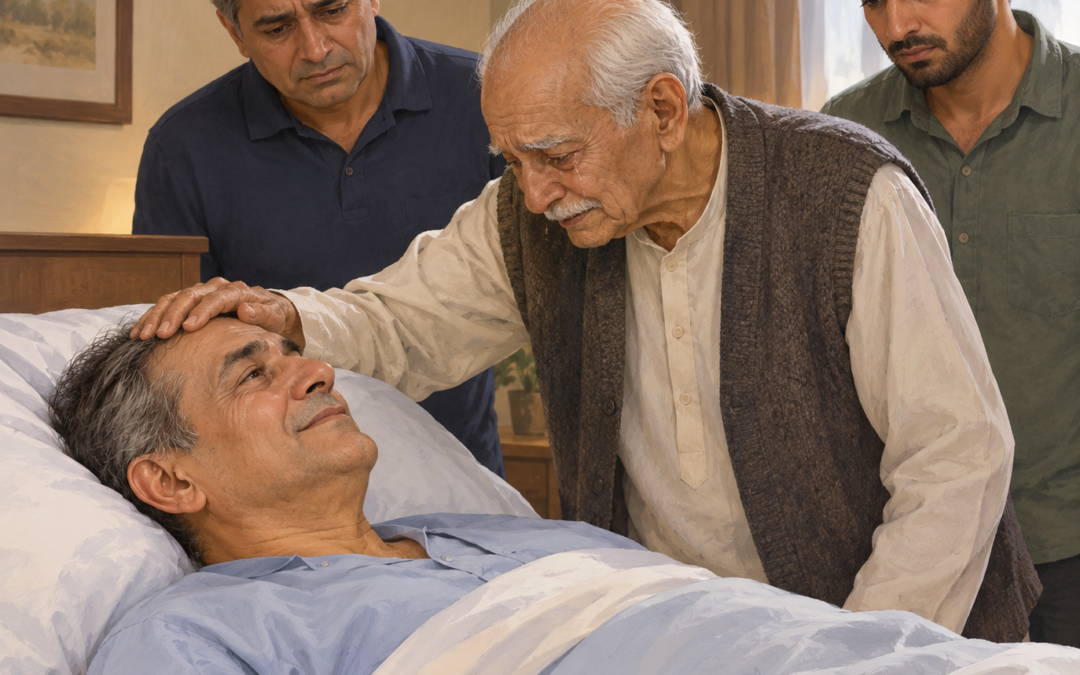
I noticed that Daada’s eyes had turned misty. Prakash uncle looked sorry as he lay with his eyes closed. Anyone with stone determination would have melted at his miserable state, and Daada was such a lovable person who always toiled to bring happiness to others’ lives. It was but inevitable for him to shed a tear or two for anyone in this situation.
Daada gently stroked his forehead.
As if Daada’s touch had an electrifying effect, Prakash Uncle suddenly opened his eyes.
Then, to the astonishment of everyone present, the same person who had been staring into nothing blatantly broke into a smile with every trace of recognition. At the same time, hot tears began flowing incessantly from Daada’s eyes.
I had never seen his iron resolution shaken thus except once when he had cried uncontrollably on my father’s death.
In a flash, my sixth sense prompting me, I impulsively ran down to the office. Rummaging through the registers, I spotted the one that was two and a half decades old, in which Daada’s admission to the home had been recorded.
His name, which I always remembered as soothing, was written as Mrityunjay Sawant, and in the column for the nearest kin and contact details, it read Prakash Sawant.
A cool breeze passed through the room, generating a musical note as it ruffled the leaves of the mango tree in the backyard.
My dad was smiling at me from behind the garlanded photo. It looked like he was saying, “By taking the responsibility of running this home, today you have given a new lease of life to a dying soul. A son who, in the vigor of his youth, had abandoned his dad must have learned a valuable lesson today: that LIFE IS A COMPLETE CIRCLE.
In return for his imprudence, he was brought to the same situation by his son.” I made no efforts to fight back my surging tears and allowed it to flow. They were the tears of happiness and contentment.
“I promise to continue with this benevolent work, Father,” I said.
Feeling a warm touch on my shoulder, I turned back to see Shraddha, lending me her support as always.