
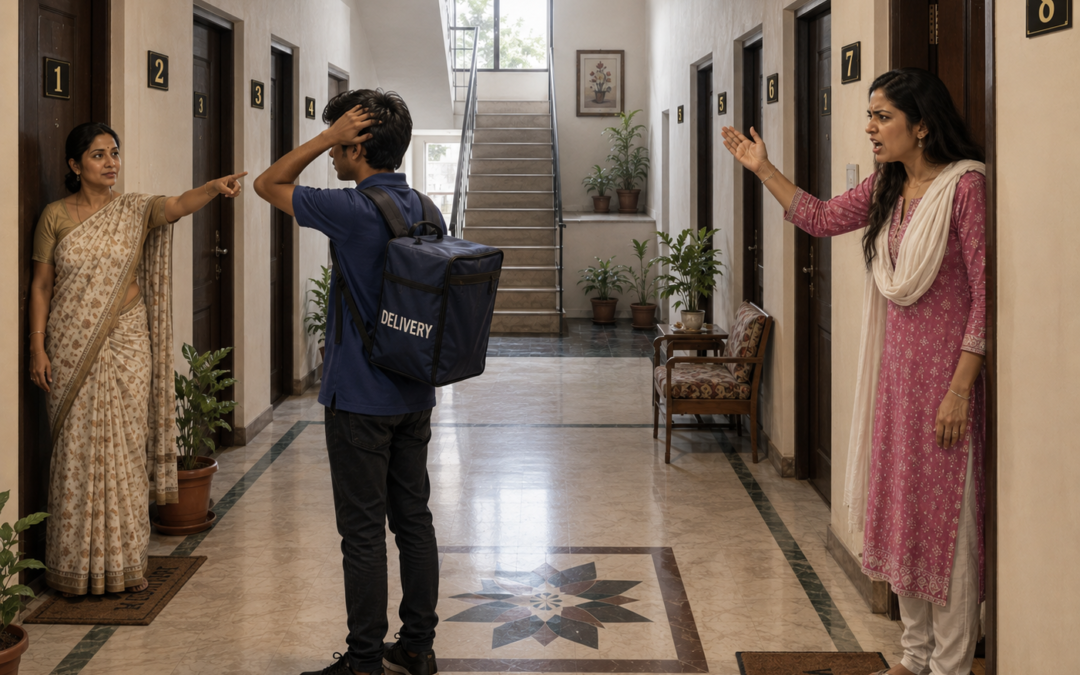
Familiar dispute echoed throughout the apartment complex again this week.
“Flat Eight, not Flat One! I have repeated this in the past eight weeks after I shifted.”
Kavita shouted at the delivery boy.
The bewildered boy stood outside Flat One, scratching his head, as the calm woman pointed in Kavita’s direction before gently closing the door.
Kavita had listed her address at the grocery shop, ‘Flat Eight,’ but the man behind the counter mistakenly noted ‘1,’ thinking it sounded like ‘Ek’ (one) in his dialect. Her repeated reminders fell on deaf ears. The local grocery store was the only one within reach, forcing her to rely on this same delivery boy while juggling a demanding work schedule.

“It’s not his fault, ma’am,” the watchman chimed in, trying to defend the boy from his home town. “Your names jotted also sound quite alike—the first four letters match!”
“Oh, so this is somehow my fault?” Kavita retorted.
‘It’s just a little mix-up. So why is Kavita making such a fuss?” Mrs. Kanwal, her neighbour, murmured.
Her colleagues were in for a hearty laugh when they discovered why Kavita had approached HR.
“Seriously? She wants to switch the apartment the company gave her?” one colleague questioned.
“She should feel fortunate to have a place in such a prime area, only fifteen minutes from work,” another chimed in.
The HR representative clarified that Kavita would need to remain in her assigned flat for at least eleven months.
Disappointed, Kavita exited the office and headed towards St. John’s Hospital, where she was due to collect test results from the previous week.
It had begun with persistent fatigue. The iron supplements prescribed did little help. Initially, Kavita attributed her weakness to the stress of relocating to a new city for her job, but her health deteriorated, and the doctor prescribed additional tests.
Now, seated across from a somber doctor, his words were like a foreign language. Gradually, however, the gravity of the situation dawned on Kavita. She was facing what many referred to as blood cancer.
“Well, it’s not all bad,” the doctor attempted to infuse some optimism. “I’ll start the treatment soon.” He paused, broaching the subject of a bone marrow transplant, likely in three months.
“We can register you for a bone marrow donor registry. If you are lucky you may get a compatible donor.”
While Kavita was financially stable at thirty-three, the reality of being utterly alone in this city hit hard. Her parents, who lived a life of shadow, had not left their hometown for the past decade. Knowing their agony, Kavita had kept many things away from them, not wanting their anguish to intensify.
The days ahead proved to be excruciating for Kavita.
One morning, with her medical file in her hands, Kavita was waiting outside her building for an Uber to visit the hospital. Suddenly the world around her turned black and she collapsed.
When Kavita regained consciousness, she found herself lying in a bed at St. John’s Hospital.
“You fainted outside your building,” the doctor explained. “The nurse on duty told me that fortunately, someone saw you collapse and rushed you here in time.”
Too weak to speak, Kavita closed her eyes.
Kavita was discharged. She was to return in ten days for her next chemotherapy session.
However, after a week, Kavita was asked to come to the hospital.
“There is good news,” the doctor said. “We have found a perfectly compatible donor for your bone marrow transplant. If you’re willing to proceed, we’ll begin the formalities immediately.”
Kavita nodded.
The following morning as she signed the consent forms, countless questions crowded her mind. Who could this person be? Such selfless souls still live in this otherwise selfish world.
“I don’t know whether my donor wishes to remain anonymous,” Kavita told the doctor, “but I’’d like to thank the person.”
The doctor quietly opened the adjoining door.
Standing there was the calm woman from Flat One.
“This is your donor,” the doctor said. “She insisted on completing every test before telling you.”
Only then did Kavita whisper the name she had buried beneath ten years of anger.
“Kavisha…”
The quiet neighbour from Flat One, who never complained about misplaced grocery deliveries, or got upset at Kavita’s outbursts directed towards her, was in fact her elder sister. Years earlier, Kavisha had eloped with Anwar, belonging to a different faith when their parents tried to force her into a marriage with a cousin. Their family had been torn apart. Humiliated by society, their parents became fearful of allowing Kavita even the freedom to study abroad. Even now she had to stand her ground to take up this lucrative job, away from home. Kavita had spent a decade blaming her sister for every dream she believed had been stolen.
Neither sister could hold back her tears.
“I never expected your forgiveness,” Kavisha said, “but I couldn’t let my only sister fight this battle alone.”
While Kavita had spent weeks resenting the neighbour in Flat One, Kavisha had silently watched over her, rushed her to the hospital when she collapsed, volunteered for painful compatibility tests without revealing herself, and offered the one gift that could save her life.
The distance between Flat One and Flat Eight had never been measured in a few steps across a corridor; it had been ten years of hurt, finally crossed by one sister’s quiet act of love.
This story has been written for a prompt- An apparently insignificant character assumes the role of protagonist in the last two paragraphs.
A touching story.
Blood is thicker than water; it is true in this story.
Thank you.