
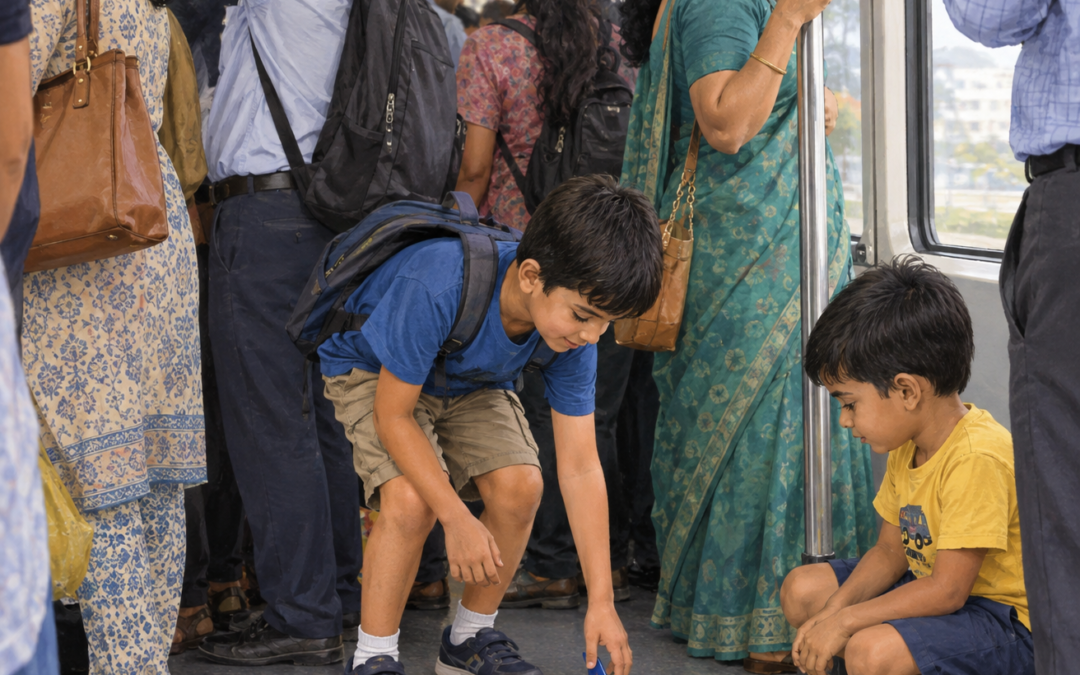
The evening rush hour crowd on the train was overwhelming. It was no different from the morning hours, except that in the morning, commuters dressed in their finest focused on preserving their attire as they made their way to work. In those moments, they collectively agreed to avoid pushing and shoving. But now, as the train lurched with each rapid acceleration, it felt as though the city’s population had doubled; a throng of harried commuters desperately jostled for spots to stand, all pretense of civility thrown out the window as they rushed home.
Public transportation was not my usual fare, but today my car suffered not one, but two flat tires!
I knew deep down who was ultimately responsible: it was Rohan, the new kid in the neighbourhood, whose reputation for destruction was already becoming legend. Deflating tires was his pastime.
Two weeks ago, my wife had barely contained her excitement when they arrived. “They have a son! He looks almost our Manat’s age. What a blessing! Now our boy will have a friend next door to play. Let’s invite them over for tea tomorrow!”
Being a very sociable woman, my wife set the decree, and there was little to do but put on a forced smile as Hari, Sunita, and their seven-year-old son Rohan arrived at our doorstep the following evening.

As soon as the boy entered, havoc commenced. He managed to topple my rose pot, sending soil and blooms scattering across the entryway. Hari, with frustration lit on his face, tried to pin the boy, but I, the ever peace-maker, urged him to let the boys play, hoping this would somehow restore order. What followed was pure pandemonium as Rohan let out a series of screams while dashing around the house, toppling more things on the way. Manat hurried after him, as if in a frantic attempt at future friendship, but ended up getting almost strangled.
The moment our guests left, I collapsed onto the sofa, physically exhausted and mentally drained. I seriously felt they should have declined the invitation, given the devastating behaviour of their son, but even that would have been written off as ‘rude’ behaviour by us.
In the week that followed, I learned that the boy had also wreaked havoc on Sharmaji’s glass window, and had almost decimated Ahuja’s rearview mirror with his baseball bat.
The members of the twenty-apartment complex planned to convene a meeting to find legal ways to vacate the family and send a notice to the landlord. Some of them, with children Rohan’s age, thought he was a bad influence.
Now, sitting on the train and eagerly anticipating my stop, the second from here, I mentally prepared myself for a serious conversation with Hari’s family regarding my deflated tires, even though I was aware that they would dismiss any concerns about their precious son.
Just then, my thoughts were interrupted by a young boy, likely no older than five, his face lit with an infectious smile as he played with a toy airplane. His mother was wrapped up in a phone conversation.
Her conversation was shattered the very moment her little boy began to cry. His toy airplane had slipped from his tiny hands and fallen to the ground, and at that moment a bustling crowd got in as the train halted.
The airplane would have been crushed to pieces, but without preamble, a boy who had just gotten on dashed forward, bent down, and retrieved it. At that moment, the train jolted unexpectedly, and a heavy foot came down onto the boy’s hand. To my astonishment, he didn’t cry out in pain; instead, he salvaged the toy and handed it over to the sobbing child. When the older boy looked up, I was taken aback to recognize none other than Rohan, the neighbourhood kid.
He had boarded the train from this station.
But where had he gone? The question lingered in the air. Since he first appeared two weeks ago, the young boy had become something of an enigma to the neighbours. Rumours whispered through the community that he hadn’t started school yet.
His mother hurried towards Rohan and nursed his hand. She greeted me with a smile. Sensing the curiosity bubbling within me, she said,
“We take this train every day; Rohan has therapy sessions to attend.”
Before I could probe further, she continued. “You see, he’s a hyperactive child, and we’re working together to help manage his behaviour through specialized treatment. We chose to move to your affordable neighbourhood because the doctor we’ve been advised to consult is conveniently located just two stops away on this very line. People say the doctor is an expert in treating such children. I need to enrol him in school too after he receives treatment. My child has never had formal education. I want him to attend school like your Manat and other kids of his age.” Her eyes had turned misty, stirring my heart.
Connecting the pieces, I realised why Rohan’s parents had evaded my wife’s question about his admission once school starts post-vacation, with an elegant smile.
In that enlightening moment, a wave of realisation washed over me. Life often holds deeper complexities beneath the surface, and the stories we craft in our minds can mislead us from the truth of someone’s journey.
I decided then and there to stand for Hari’s family at the meeting this weekend.