
DISCLAIMER:
THIS STORY IS A WORK OF FICTION. ALL THE NAMES USED FOR THE CHARACTERS ARE FICTITIOUS. ANY RESEMBLANCE TO PEOPLE LIVING OR DEAD IS PURELY COINCIDENTAL AND UNINTENTIONAL. THE STORY HAS BEEN WRITTEN WITH THE SOLE INTENION OF WRITING A STORY. WITH DUE RESPECT TO ALL RELIGION, THE AUTHOR WISHES TO CLARIFY THAT THE STORY IS NOT WRITTEN WITH ANY INTENTION OF HURTING ANY RELIGIOUS SENTIMENTS.
It no longer resembles the expansive courtyard it once was.
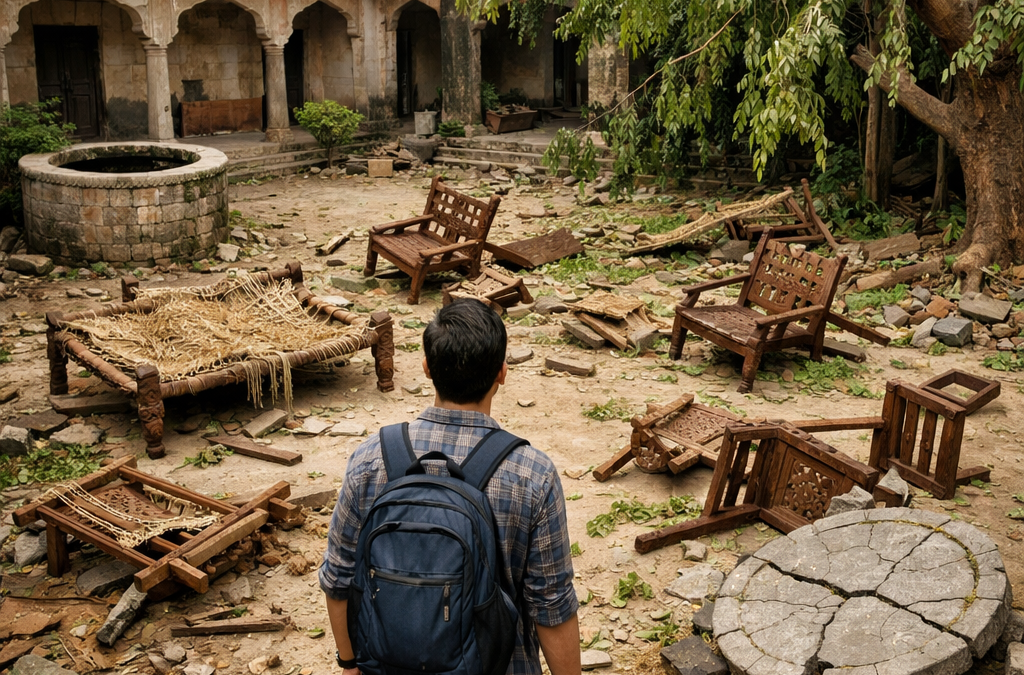
As Anwar stood at the entrance of the now shrunken courtyard, his heart twisted within him. He gazed at the square space–an area that had comfortably accommodated two large charpoys, a vast round well, and a neem tree in the far corner with its branches gently drooping. It also housed a sturdy stone designed for washing clothes, a twin stone beside it, and four intricately carved chairs ready for any guests who wished to linger for a while in the breezy courtyard before entering the six-room mansion-Noor Villa.

Though the courtyard still existed, it was not the same place Anwar had cherished during his twenty-two years. Now, the devastating news of communal riots in his hometown had brought him from the capital city, where he pursued post-graduation, only to be shocked to see its shrunken state.
Everything was present, yet nothing was as it should be. The two charpoys—one where Dadu would sit smoking his hukkah while Dadi recited verses from the Holy Quran, seated on the other—now lay in fragments that claimed more space than they did when intact. The beautifully carved chairs had met a similar fate, strewn about in disarray.
The neem tree that used to lean towards the washing stone, as if it sought to eavesdrop on the conversations between Ammi and Abu, while Ammi washed the clothes and Abu sat on the other stone, was now a sad sight with broken branches and withered leaves scattered across the diminished landscape. And what had happened to the well’s cover, a detail Dadu was always meticulous about? It lay in pieces at another corner of the shrunken courtyard.
The silence that enveloped the space, caused Anwar’s heart to beat erratically.
With arms raised, he gazed up at the open sky, a silent prayer on his lips; even the sky seemed smaller, a faded blue caught between tangled electric wires overhead.
If this courtyard had suffered such devastation, what then had become of the house and its inhabitants? Anwar dragged his numb legs forward.
“Abu, Ammi, Dadu, Dadi, Ayeshaaaaa!” he called out, but only met with a deafening silence.
Entering the house, that had rooms arranged around a central space, Anwar was more than shocked to see the doors of the rooms lying askew, ripped from their hinges, horizontally scattered and crowding the very center.
Anwar’s footsteps echoed louder than usual as he rushed from room to room, struggling to grasp the extent of the destruction. Tears fought to spill from his eyes as he took in the damage: beds broken, cotton stuffing from mattresses scattered, pillows strewn about.
Where was everyone? Had they abandoned this place, unable to live in such confined conditions?
He neared the kitchen, half-expecting to find his family—known for their hearty appetites.
He paused at the threshold, confronted by the shrunken kitchen, with utensils strewn everywhere and the chullah irreparably damaged.
This was once the heart of the home. The family always ate together. Ayesha would ever arrive late, facing Dadu’s reprimands for her lack of punctuality. Anwar would draw immense pleasure to see his sister being scolded. But then soon he would make her laugh with some silly joke. Everyone would join. Laughter would resonate throughout the kitchen, bouncing off the utensils, echoing joyfully. But now, as Anwar stood in that quiet kitchen, he felt the weight of calamity pressing down on him.
“Abu, Ammi, Dadu, Dadi, Ayesha…!” he shrieked once more, flinging open the last door, the only one that was left intact, at the farthest corner of the house—the guest room! The huge guest room seemed to have diminished in size, but not due to a broken bed, not because of scattered pillows, and not because the mattress stuffing had been torn apart. It was the haunting presence of four charred bodies that made the room feel so constricted.
Anwar counted the remains like a possessed man, “One, two, three, four…” He repeated the count, desperately hoping it might turn to five. He was somehow able to guess, amidst the four burnt figures, though beyond recognition, his sister’s lifeless body was absent.
They had taken her. Oh, no! A beautiful girl, at the cusp of her youth! Anwar shivered at the very thought.
His heartbeat quickened when a faint cry from the backyard rung in his ears.
Amidst a jumble of scattered twigs meant for kindling the chullah, he found his sister Ayesha, almost devoid of clothing, blood staining her thighs and bite marks marring her skin. Wrapping her in the bedspread he had carried in his bag, Anwar embraced her tightly. They wept together, brother and sister united in grief.
The courtyard could be restored, the rooms repaired, the wires dangling overhead could be fixed, revealing the vast sky once more; even the doors could be mended. But how could one repair the shrunken state of humanity wherein people targeted one another in the guise of communal riots?
In the distance, a police siren wailed. As it drew closer, Anwar held onto Ayesha, hoping it heralded some much-needed relief for them both.
Author’s Note:
The story is based on the communal riots that triggered in Gujrat soon after a train carrying Hindu Karsevaks returning from Ayodhya was burned on 27th February 2002 at Godhra, resulting in the death of 59 Karsevaks.
https://share.google/sIsWQvqapCl0PZfE0
Very well penned dear Sudha! Emotional.
It is disturbing but it’s also true that these incidents do happen and you have brought it out well through your story.
Hard hitting 🙏🙏
Thank you for reading and sharing your views about my story.
So well written. The style, language and the expressions… loved it
Thank You.