
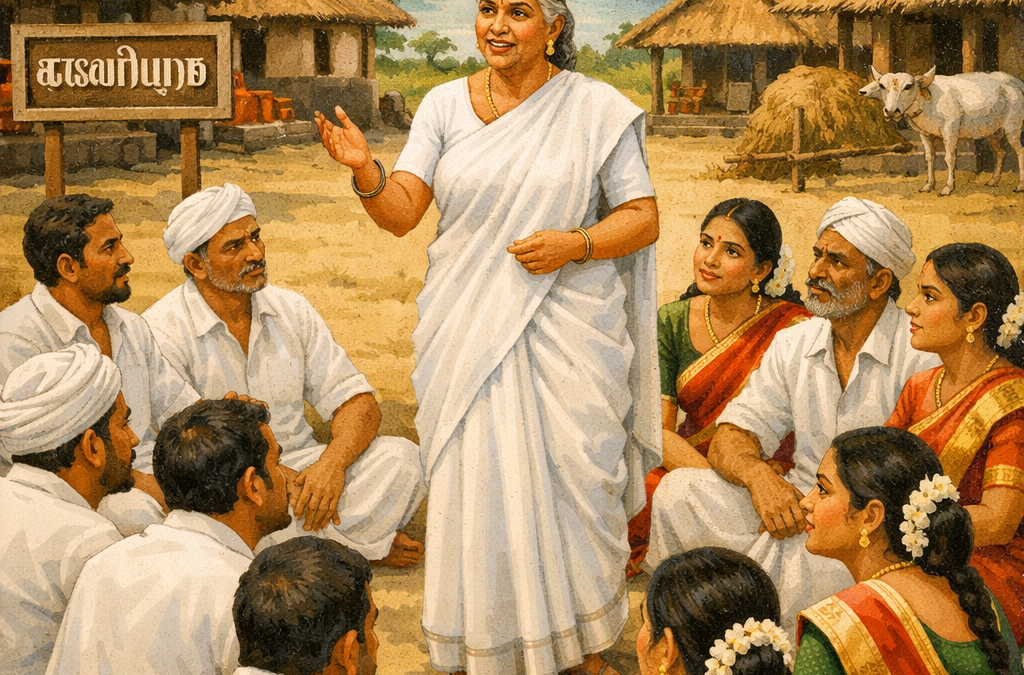
Nestled between valleys, life in Kaveripuram, a village in Tamil Nadu, had always been generous. The soil was fertile, the rains dependable, and the granaries of every household brimmed with rice and pulses.
Every day, there would be festivities in the village.
One year, the panchayat elected a new headwoman, Meenakshi Amma, a widow in her sixties.
“Whatever kind of wisdom propelled the Panchayat to give us a lady head. Now she will be dancing on our heads for another five years,” Muthupandian, the richest amongst the villagers, grumbled.
Each had an opinion about a female head. However, all had to respect her words and go to the square that evening as summoned by her.

It was there that Meenakshi Amma introduced a rule that startled everyone.
On every new moon (Amavasya) and full moon (Purnima), each household was required to contribute:
- One measure of rice
- One measure of a pulse (announced a day prior)
A meticulous record would be maintained about the contribution. “And if anyone plans to defy this rule, they will suffer.” Meenakshi Amma brandished her pointer. The square filled with murmurs. Yet none dared defy her openly, for the panchayat had given her authority, and rules in Kaveripuram were not to be broken.
“Bah! What suffer? She is hoarding our food,” said Raghavan, a wealthy farmer, while returning home. “Fattening her own granary with our sweat. I am not obeying.” A few thought Raghavan’s anger was justified and decided to follow suit.
Month after month, the ritual continued. The square filled with sacks of rice and pulses. The murmurs grew louder. But the rule remained, and the villagers complied, some grudgingly, some faithfully.
Exactly one year after the rule began, the skies betrayed Kaveripuram. The monsoon clouds drifted away without shedding a drop. The rivers shrank, the wells dried, and the once-green valleys turned brown and brittle. Villagers watched helplessly as their crops withered. By harvest season, there was nothing to reap. Panic spread like wildfire. Families who had squandered their wealth now realised that they would soon face empty kitchens and rumbling stomachs.
It was then that Meenakshi Amma summoned the villagers to the square. It was neither Amavasya nor Purnima, and she hadn’t announced which pulse to bring. It made no difference, for no one had pulses left to donate.
People walked to the square, wondering what was in store for them.
Meenakshi Amma’s men lead them to the warehouse. Inside lay pulses and rice neatly stacked. The villagers stared in disbelief.
Meenakshi Amma spoke: “You thought I was greedy. But I was saving for you. Every grain has been preserved. Each of you spent lavishly on food and drinks, selling a very small portion of the yield, thereby weakening your pouch, too. And even after feeding cattle, food just found its way into the flowing river almost every day. Now look what has happened?”
The villagers stood with their heads hung low.
Meenakshi Amma’s assistants began distributing bags of rice and pulses to each household according to the records kept. Those who had faithfully contributed received their full share back. Their eyes filled with tears of gratitude. “Amma has saved us,” they whispered. “She saw what we could not.”
But not everyone rejoiced. Some who had secretly defied the rule found their names marked with gaps. They received only partial bags or nothing at all. Their protests rang out in the square. “This is unfair!” cried Raghavan. “We are starving too!” The others who had kept him as a role model echoed their resentments.
Meenakshi Amma’s reply was calm but unyielding: “You chose not to trust. You squandered when you should have saved. This is not punishment—it is consequence. Let this be your lesson.”
That night, families carried home their provisions, relief washing over them. Kitchens lit fires of joy. The murmurs of suspicion that had haunted Meenakshi Amma were silenced, replaced by respect and awe.
The drought lasted forty-five days, but Kaveripuram endured under Amma’s watch. No family that had obeyed the rule went hungry. And even those who had defied her learned humility, borrowing from neighbours and vowing never to squander again, and always follow the rules laid by the head.
By the time Kaveripuram was blessed with rains, the village had changed. People had grown wiser. They stored grain, saved money, and remembered the bitter taste of scarcity. Meenakshi Amma’s rule became tradition, passed down as wisdom. Every Amavasya and Purnima, the square filled with offerings—not out of fear, but out of faith.
Years later, elders of Kaveripuram would tell the story to children: “A village sits between valleys, blessed with abundance. But abundance can blind. One woman taught us that prosperity must be preserved, not squandered. She made us give when we did not want to, and returned it when we needed it most. That is why Kaveripuram still thrives.”
A boy may ask, “If there hadn’t been a drought, what would Amma have done with the grains?”
And then an elder woman would quote Meenakshi Amma, ‘If there had been no drought, I would have sold all these grains and distributed the money amongst the villagers, teaching them the importance of saving, whether it be grain or money.’
Thus, the moon’s rhythm became the village’s rhythm, and grains of wisdom spread in Kaveripuram.
The story has been written for the prompt:There was a rule in the village and everybody must follow it without questioning.