
Poongothai felt a subtle tug on the edge of her saree. Anticipating the identity of her small assailant, she turned around with a mix of affection and curiosity. As she had suspected, standing there was her seven-year-old son, Maran, his cherubic face lit up by an infectious smile. “Amma,” he exclaimed, his eyes wide with excitement, “Pandi told me that they’re going to pick the jackfruits today in the bungalow!”
Poongothai leaned down and cradled her son’s round, cherubic face in her hands, showering him with a warm kiss on his forehead. “Yes, my dear Maran, you’re absolutely right, Muthu Mama will indeed pick the jackfruits at eleven this morning!” she said playfully, pinching his nose affectionately. Maran responded with a delightful eye roll.
“Yummy! Amma, could you please make jackfruit paste with half of it? And may I have ten pieces from the other half? I promised my friends!” he beamed, bursting with anticipation of receiving their usual quota of one whole jackfruit.
Hearing her son’s innocent request, Poongothai felt a swell of pride. It was both heartwarming and amusing to see such a small boy exhibit such generosity; he was ready to share his treasured treat with his friends. She knew that half a jackfruit typically yielded about twenty pieces, yet he promised to give half of it to his friends.
With a knowing smile, she nodded, setting her heart on making this happen for her son. She quickly scurried to prepare for the day ahead. Poongothai worked as a maid at the village’s only bungalow, owned by the ever-kind Kamakshi Ammal, who was well known for ensuring that her employees felt valued and fulfilled in their roles.
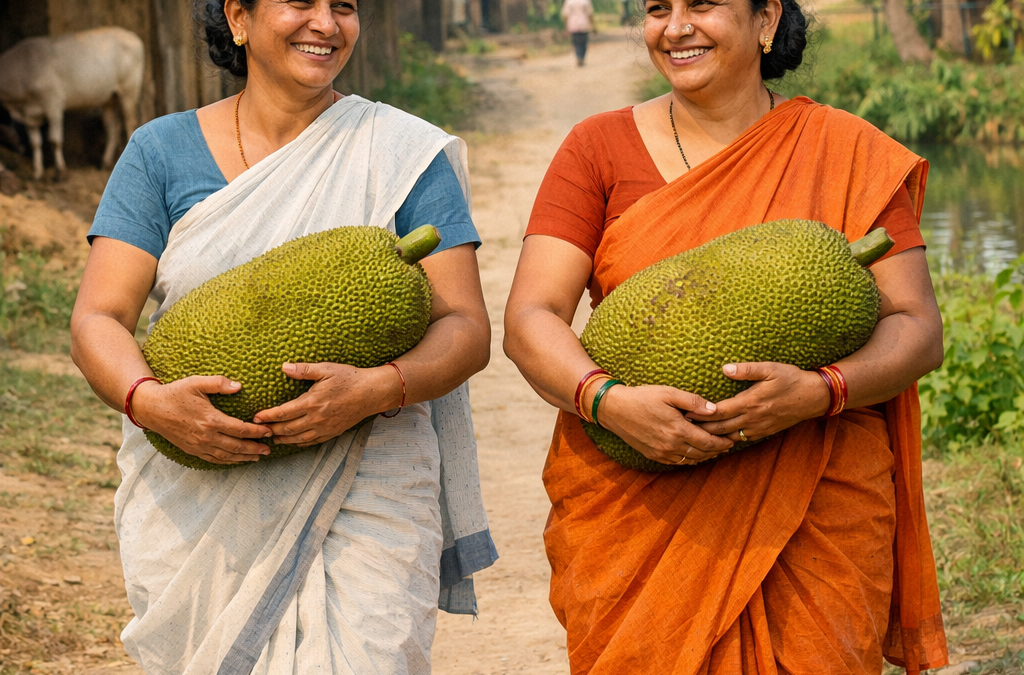
Every March, Kamakshi Ammal’s garden would explode with an abundance of jackfruit. During this fruitful season, Poongothai, her brother Muthu—the dedicated gardener—along with the bungalow’s driver Ponappa and Selvi the cook, would each receive a whole jackfruit as a special treat. This was a gesture the four deeply appreciated, given the high cost of such a delicacy that often felt out of reach for families like hers, who lived modestly.
However, their lives took an unexpected turn a few months ago when Kamakshi Ammal fell ill and became bedridden, a heartbreaking development for the staff in the bungalow. Muthu’s wife, Anbarasi, was called in to provide care, which, was a blessing in terms of extra income, as Muthu faced the burden of repaying a hefty loan taken for life-saving heart treatment for their second child.
Unfortunately, when Kamakshi Ammal’s sons and their respective families moved into the bungalow shortly after their mother fell ill, life for the staff became fraught with challenges. The newcomers brought a decidedly less warm atmosphere, leaving Poongothai anxious about the future, especially regarding the generosity she had come to expect from Kamakshi Ammal with respect to the jackfruits.
After losing her husband two years prior, Poongothai was now solely responsible for raising Maran. She felt a deep-seated yearning to bring home a whole jackfruit for him, to see the delight on his face when he returned from school.
As Poongothai, along with Anbarasi and Muthu, made their way towards the bungalow that morning, the cousins, Maran and Pandi, left for school. Pandi, being the older by a year, and Maran walked side by side, animatedly discussing the jackfruit they were excited to receive that evening.
By 3 PM, Muthu had completed plucking the fruits. To his dismay, he discovered that they had gathered only twenty-six jackfruits, a disappointing seven fewer than the previous year’s bumper crop. The two daughters-in-law of Kamakshi Ammal quickly cast disapproving glances at the meagre harvest, clearly unimpressed. They directed Muthu to carefully store the jackfruits in a designated corner of the garden.
“Selvi,” one of the daughters-in-law addressed the cook with an air of authority, “make jackfruit paste from twelve of these, and turn the five that aren’t quite ripe into chips.” Selvi’s face fell at the prospect of such a burden, clearly overwhelmed by the additional workload. Sensing Selvi’s concern, one of the ladies added, “Poongothai and Anbarasi can help you.” With that decision made, Poongothai quickly calculated the distribution. With only nine jackfruits left, it meant that after each of the four of them would receive one, counting Muthu and Anbarasi as a single unit, five would be left.
Perhaps the sons of Kamakshi Ammal and their families would relish pieces from the remaining five. Poongothai couldn’t help but notice the small tribe of children in their bungalow, aged between eight and thirteen, who had just alighted from their school bus. Their eyes widened in awe at the sight of the piled-up jackfruit.
“Bring a large knife,” the elder daughter-in-law instructed Selvi curtly before the servants were dismissed for the day. Once Selvi received the knife, she was directed to cut one jackfruit into four equal pieces. “Take one piece each and peel three of the remaining eight for today. You can tackle the paste and chips preparation tomorrow,” she directed, her voice firm. Anbarasi and Poongothai exchanged worried glances upon hearing this.
The thought of their sons returning from school only to find a mere fraction of the jackfruit they had envisioned filled them with anxiety.
How would they explain to the boys that, rather than an entire jackfruit, they would only have a quarter piece?
The weight of Maran’s promise to share with his friends hung heavily on Poongothai’s heart, making her more desperate to fulfill his dreams. She paused, determined to figure a way out, lingering in that moment as her mind raced with possibilities.
She paused briefly, locking eyes with Anbarasi, a silent yet profound exchange of worry passing between them. The unspoken message was clear: their collective concern for their children loomed large in their hearts. Anbarasi caught the quiet gesture on her sister-in-law’s face.
“Akka,” Poongothai addressed the elder daughter-in-law of the house.
“Please take back these two pieces of jackfruit. Neither my son nor Anbarasi’s son has been feeling well, and indulging in such luscious fruits would not serve their recovery. You know as well as I do how children can hardly resist such tempting delicacies.”
With that resolute declaration, they placed the jackfruit aside and made their way towards the gate. As they approached, Anbarasi felt compelled to share the day’s events with her husband, who had to man the gate till 7 pm. He nodded in quiet acknowledgment of their decision.
“The rich certainly have their strict ways,” he muttered, his voice laced with a hint of resigned amusement.
“Pandi may cry,” he warned, a father’s instinct rising to the surface as he thought about their son’s unyielding desires.
In that same moment, Poongothai reached into her purse and pulled out two delicate silver toe rings that shimmered under the sunlight. The pieces glinted like fleeting hopes in their eyes. The couple looked aghast.
“What good will these do for a widow?” Poongothai mused aloud. “Instead, let’s sell them and use the money to buy two jackfruits for our children. They deserve a taste of joy, don’t they?”
Anbarasi’s first instinct was to dissuade her. “I don’t know if and when I can repay,” she urged, concern etching her features. Yet, Poongothai’s resolve began to soften her objections as she envisioned Pandi’s eager face, a mix of anticipation and longing. She was acutely aware that even securing one jackfruit posed a significant challenge for them—the price hovered around 90 rupees, an amount far beyond their modest means.
With a determined spirit that could not be dampened, Poongothai brushed aside Anbarasi’s worries, clasping her hands gently. Together, they exchanged determined looks, and Poongothai nodded towards Muthu.
At the local jewellery shop, the man behind the counter assessed the toe rings and offered them a sum of 200 rupees—a windfall they hadn’t anticipated. With that newfound money clutched tightly in her hand, they bought two jackfruits for Rs. 90 each.
Poongothai led Anbarasi to a nearby temple. “Let’s donate ten rupees each to seek blessings for our sons,” she proposed. And so, with prayers lingering on their lips, they both uttered, “Forgive us, Lord, for misrepresenting the state of our children’s health.”
Anbarasi’s voice reflected deep concern, “The boys are still too young to comprehend that these fruits did not come from the luxurious bungalow. But what will we do next year? Can we truly afford the indulgence for them again?”
“Let’s not dwell on the future just yet,” Poongothai replied, her smile unwavering. “Let’s instead focus on the happiness we will see on our children’s faces this very moment.”
Together, the two women walked side by side through the streets, their grip on the prized jackfruits firm yet proud. What mattered most was the joy they were about to bring home, a simple act that held the power to brighten their children’s day amidst the shadows of their worries.
This story has been featured in thenonline edition of The Wise Owl magazine June 2026 edition.